
The Difference Between Management Consulting and a True MSO Partnership
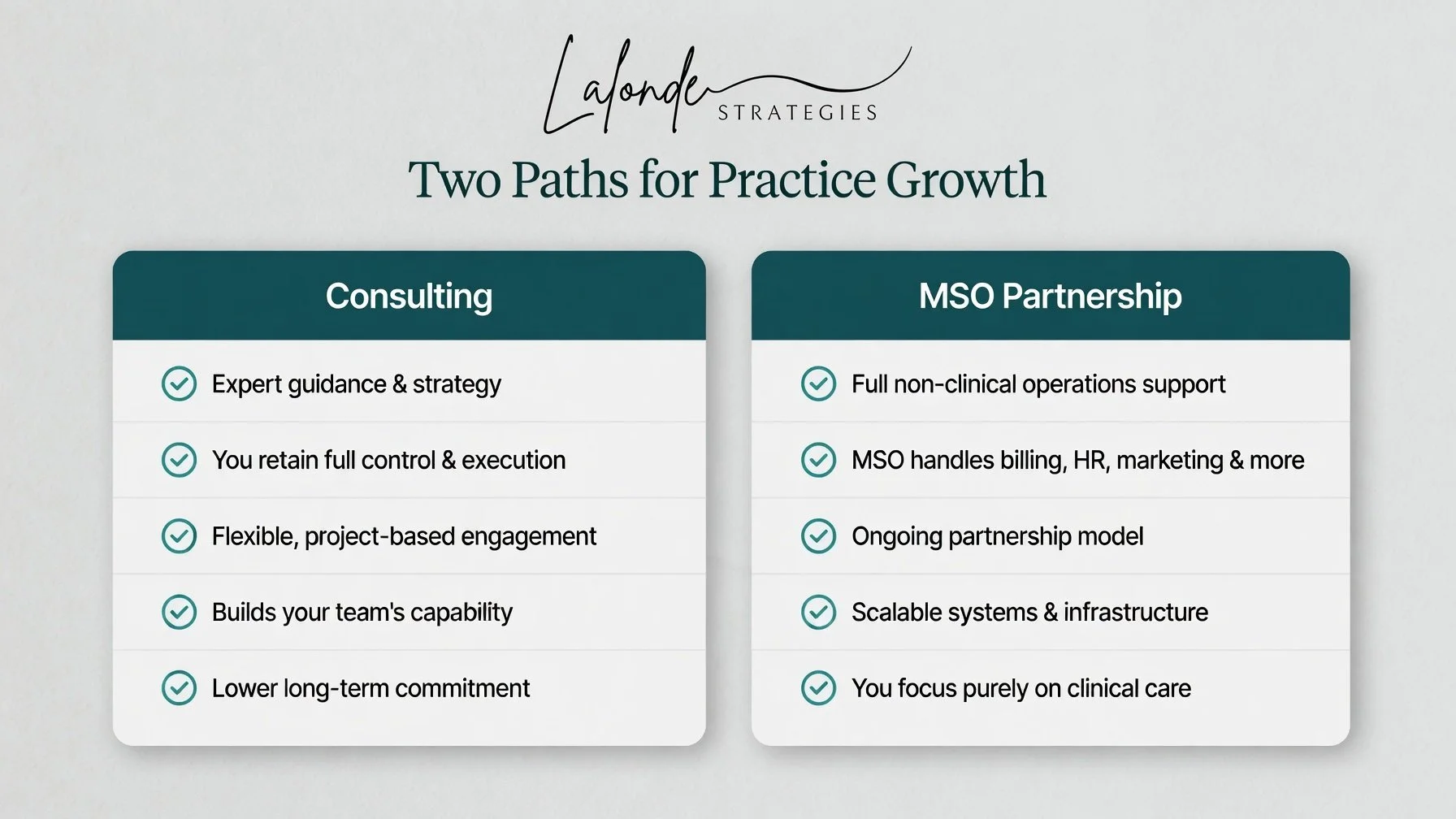
Two paths for practice growth - and why the distinction matters more than most owners realize.
When healthcare practice owners feel the weight of operations, they often reach for outside help. The most common first stop is a management consultant. But there’s an important difference between hiring a consultant and entering a true Management Services Organization (MSO) partnership.
Understanding that difference can save you time, money, and a lot of frustration.
Consulting: Expert Advice, Then You’re On Your Own
Traditional management consulting is project-based. A consultant comes in, diagnoses issues, delivers recommendations or a strategy, and then exits. You retain full control - and full responsibility - for execution.
Typical strengths of consulting:
Expert guidance and strategy
You retain full control and execution
Flexible, project-based engagement
Builds your team’s capability through knowledge transfer
Lower long-term commitment
Consulting can be valuable when you need a clear-eyed assessment, a strategic roadmap, or help solving a specific problem. The limitation is that most practices don’t struggle with knowing what needs to change. They struggle with the capacity, systems, and consistency required to make those changes stick.
MSO Partnership: Ongoing Operational Support
An MSO works differently. Instead of delivering advice and walking away, a true MSO becomes an extension of your non-clinical leadership team. The focus shifts from recommendations to implementation and sustained support.
What a true MSO partnership typically provides:
Full non-clinical operations support
Handling of billing, HR, marketing, systems, and more
An ongoing partnership model rather than a one-time project
Scalable systems and infrastructure
Space for owners and clinical teams to focus purely on care
The goal is not a polished report. The goal is a practice that runs more smoothly month after month - so leaders can actually lead.
Why This Distinction Matters
Many practice owners have experienced the consulting cycle: insightful recommendations, initial enthusiasm, then a return to the same daily chaos because the team lacked the bandwidth or systems to implement everything.
An MSO model is designed to close that gap. It prioritizes:
Structure over temporary motivation
Systems over one-off advice
Long-term partnership over short-term projects
This approach aligns closely with our philosophy at Lalonde Strategies: Run Better. Lead Easier.
We believe good systems should serve people - not the other way around. When non-clinical operations are handled with clarity and consistency, clinical teams gain the capacity to deliver better care, and owners regain the ability to lead with intention instead of constantly putting out fires.
Which Path Is Right for You?
Consulting may be the better fit if:
You need a strategic assessment or fresh perspective
You have internal capacity to implement recommendations
You’re solving a defined, short-term problem
An MSO partnership is often the better fit if:
Operations feel heavy and persistent
You want ongoing support rather than a one-time project
You’re preparing for growth or multi-location expansion
You want to reclaim time and focus for clinical leadership
Neither path is inherently better. The right choice depends on your current capacity, goals, and how much operational weight you’re carrying.
Final Thought
Advice is helpful. Sustainable systems are transformative.
If your practice needs more than a report - if you need a partner who stays to help build and maintain the operational foundation - then exploring a true MSO relationship may be the clearer next step.
Ready to explore the difference in real terms? We’d be happy to have a conversation about what ongoing operational support could look like for your practice.
Book a consultation or reach out through our website.
Further reading
This guide was prepared by Lalonde Strategies Inc., a North American management services firm specializing in operational stability and leadership support for healthcare practices and small service businesses.
